Today, we’ll use fractal thinking to maximize customer revenue. Not a bad use case, right?
For this edition, I must give a shoutout to Perry Marshall and his book 80/20 Sales and Marketing, which I highly recommend.
Have you ever read a sentence that causes your brain to make a new connection? And when you make that connection, it’s like plugging in the missing Christmas tree light? And the entire tree lights up?
That’s how I felt when I read the following sentence from Perry:
“The 80/20 rule is fractal.”
Maybe it’s because we both have backgrounds in engineering, but like Perry, I think in terms of leverage. And that’s what his sentence refers to. Leverage.
You’ve heard the language of leverage:
“Small hinges swing big doors”
“Find the needle movers”
“More bang for your buck”
Leverage is what leads to the headlines so often used by us copywriters, like:
“Make more revenue from a smaller audience.”
“Pack on more muscle in each gym visit.”
“Double your productivity without working more hours.”
We all want more leverage. To get more from less.
Yet, despite many experts writing about leverage, few link it to fractals. Except Perry.
The 80/20 Rule Is Fractal
If you’re unfamiliar with the term, the 80/20 Rule, sometimes called The Pareto Principle or The Matthew Principle, says that 80% of your output will come from 20% of the input.
For example, 80% of a business’s revenue will come from 20% of its product catalog. Another example: 80% of a business’s revenue will come from 20% of its customers.
Experts commonly give these examples, but where’s their writing on fractals? Often missing.
Adding the fractal component to the 80/20 Rule makes the concept way, way more powerful. And it’s already impressive.
My prediction? Learning fractals first will be a more helpful way for people to grasp the 80/20 Rule.
That’s what I’m doing with this newsletter and why we’re entering the 80/20 discussion through the door of fractals.
Let’s now apply this concept to revenue maximization . . .
Below, you’ll see a visual that compares how most business owners see their customer list as opposed to the fractal thinker:
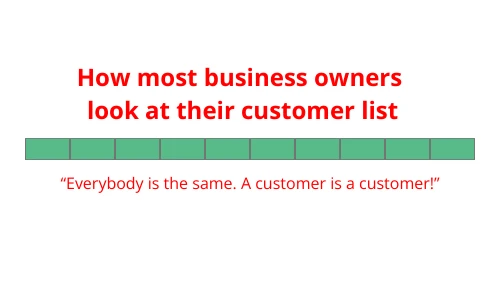
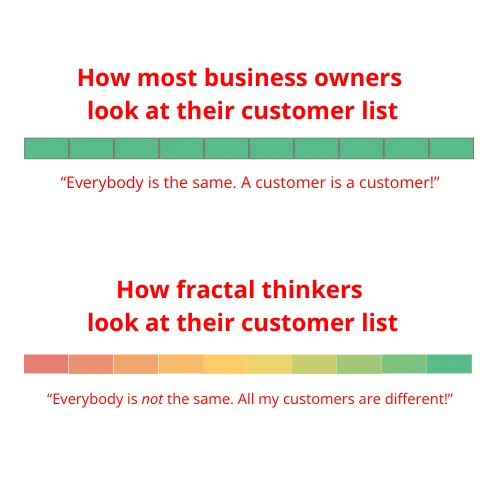
Most business owners view all customers as the same, thinking, “A customer is a customer.”
No way.
Your customers will fall on two ends of a spectrum.
Super Customers (red) - These are your hyper buyers. They purchase often and aren’t price-sensitive. If you could multiply these customers, you’d do so in a heartbeat.
Casual Customers (green) - These customers only buy once, and even that was a tough sale. Maybe they bought because you offered a Black Friday discount. Either way, from a revenue standpoint, the casual customers are not your best customers.
Here’s a more detailed visual of how a fractal thinker looks at their customer list:
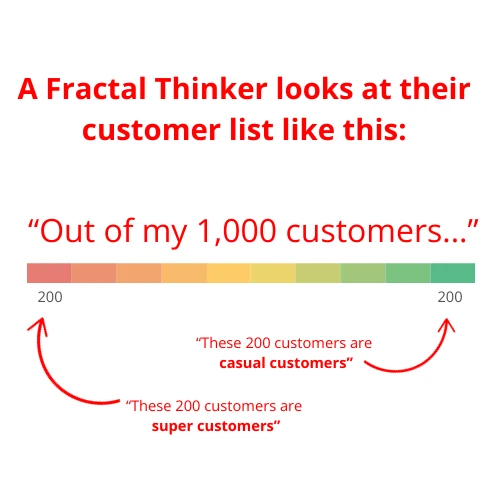
When launching and selling a product, not all customers on your list should be viewed equally. You must ask: “What is the true potential?”
The 80/20 Rule determines the true potential. It’s similar to another law of nature: gravity.
Just as gravity shapes outcomes, like the path of water flowing down a mountain, the 80/20 shapes your business outcomes.
Make sense?
Now, let’s take the critical next step: Let’s look at the 80/20 rule fractally:
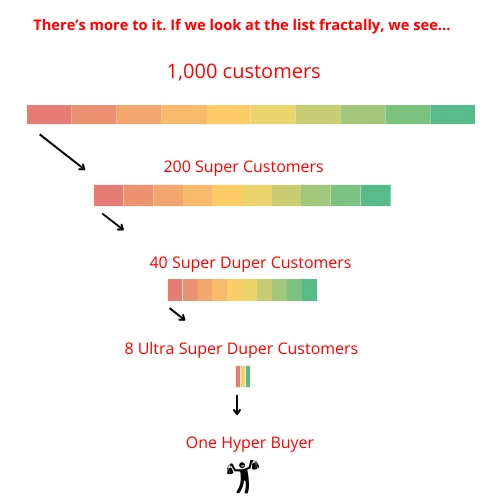
Do you see the fractal pattern? And don’t you love my sophisticated customer category names?
(Those silly names tell you something because fractals can go on to infinity, which is why I was running out of names.)
At this point, it may be helpful to show you that Russian Doll visual again (from edition #19) because it does such a good job of demonstrating the fractal pattern:
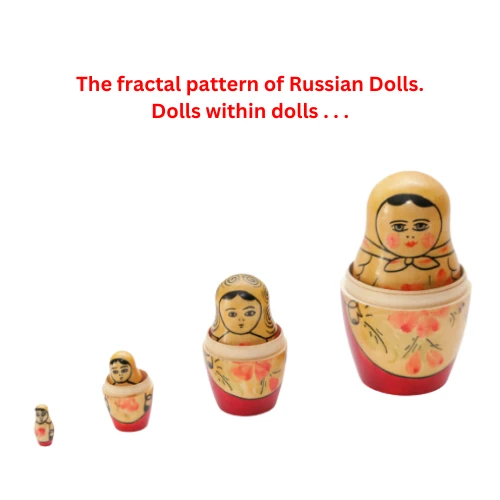
For our example, instead of dolls within dolls, we have super customers within super customers.
Let’s add numbers to this example:
- Let’s say we have a list of 20,000 email subscribers. You launch a $200 product and get those 1,000 customers. Your total revenue is $200,000.
- But what if we used 80/20 math? Plugging the numbers into Perry’s 80/20 calculator, our projected revenue becomes $1,675,218.
- Yep, we took our launch revenue from $200k to over $1.6M.
- How is this possible? Because we create products for everyone up and down the 80/20 curve. In my mind, I call this “Painting the 80/20 curve.”
Some customers are not willing to pay $200, but they are willing to pay less than $200. On the flip side, some customers are willing to pay more than $200. Much more. The 80/20 math tells us our top customer, our top hyper buyer, is willing to pay a shocking $76,750.
- In other words, if 1,000 people purchase from a 20,000 person list, and you charge $200, you have one person in that group of 1,000 who is willing to pay a crazy high amount. In this case, the top hyper buyer is willing to shell out $76,750. Imagine charging someone only $200 when they would have paid $76,750!
Now, whenever I share this way of thinking with clients, I get all sorts of questions.
“What product could I possibly sell for $76,000?”
“What about all the work involved in creating those products?”
I hear you, and those are good questions.
But please, don’t let perfect be the enemy of the good. With 80/20, it’s easy to get lost in the implementation details and miss the bigger picture.
Here’s the critical question you should answer: When it comes to the 80/20 rule, do you have a better North Star?
In other words, do you have a better rule to guide you than the 80/20 Rule?
I sure don’t, which is why I follow it.
No, I’ll never make my numbers exactly match the calculator’s. It can’t factor in everything, like my desire to create a particular product. But you can bet I’m aware of when I’m breaking the rule.
Know the rules, then break them.
And the 80/20 Rule says you should stop looking at your customer list in the manner shown below:
Instead, look at it fractally. The way I showed you.
By better understanding fractals, we can better understand the 80/20 Rule, plus so much more.
We’ve now covered two use cases for fractal thinking:
1) Fractal thinking for product creation
2) Fractal thinking for revenue maximization
And we haven’t even gotten to my favorite use case yet.
By now, you should be pretty good at spotting the fractal pattern. It does take some time since our modern brains aren’t accustomed to it.
If you’re not quite there yet, see the visual below. It shows our two use cases so far:
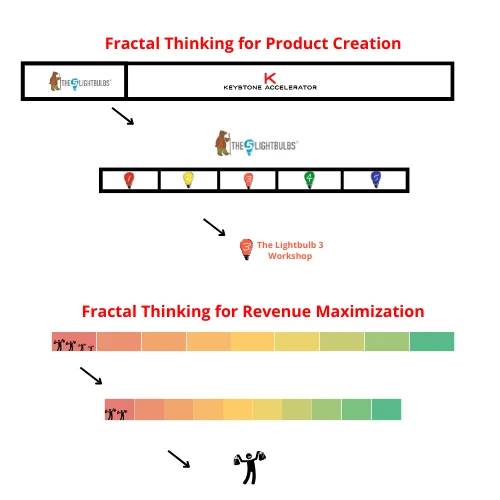
See the layered pattern?
In the coming weeks, we’ll keep going with fractal thinking.
For now, a few reflection questions:
1) Are you treating your list as a single, homogenous blob? Or are you looking at it fractally?
2) Are you making offers up and down the 80/20 curve? Most importantly, are you making offers to your hyper buyers?
3) What if you adopted fractal thinking as your North Star for every business decision? And you only diverted from it when you knew you were breaking the rule?
My awesome subscriber . . .
Reality is fractal. And if you’re not aligning your thinking with reality, you’ll always fight to swim upstream. Instead, go with the flow. Think fractally.
Rooting for you,
Billy